INVESTMENT MARKET UPDATE
SEPTEMBER 2026
What developments have unfolded in local and global markets throughout the month of SEPTEMBER?

5.30%
The highest US 10-year Treasury yield since 2002

John Ternus
Takes over from Tim Cook as Apple CEO

3.75% – 4.00%
The Federal Reserve hikes rates for the first time since 2023
CHROME WEALTH SEPTEMBER COMMENTARY
GLOBAL MARKETS
__________________
🌐 Higher for longer: oil, rising yields and a widening divide across global markets
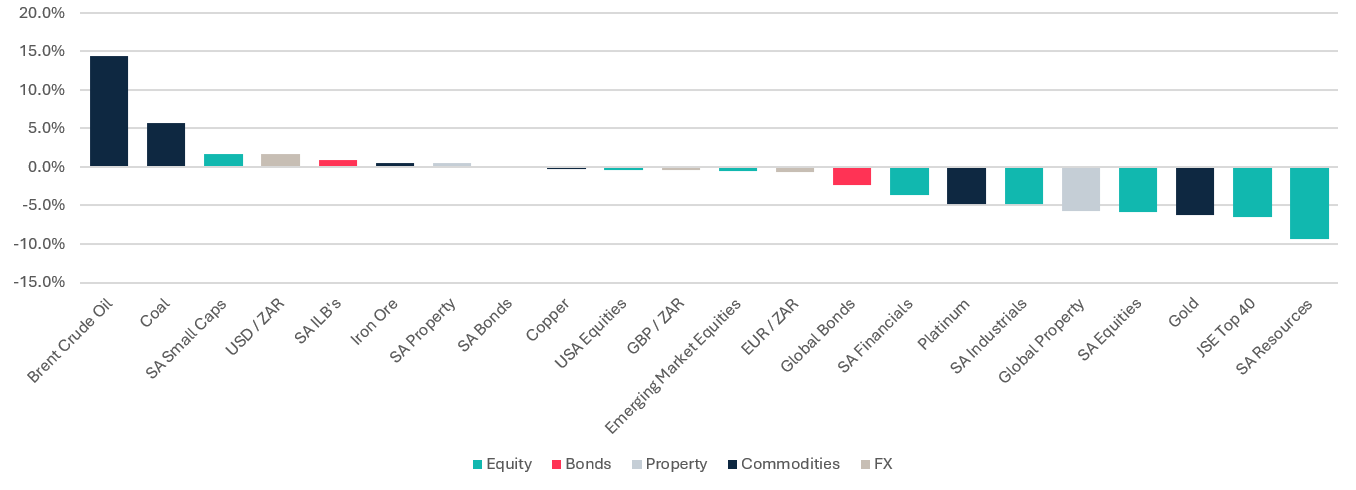
September proved challenging for global investors as geopolitical uncertainty, higher energy prices and rising bond yields combined to put pressure on markets. The ongoing conflict involving the United States and Iran continued to disrupt energy markets, with Brent crude rising 14.4% during the month. Higher oil prices brought inflation risk back into focus at a time when investors had been hoping that easing price pressures would allow central banks to become more supportive.
The result was another sharp adjustment in interest-rate expectations. The US Federal Reserve raised rates by 25 basis points, its first increase in three years, as policymakers remained concerned that higher energy prices, large fiscal deficits and strong investment spending could keep inflation elevated. Bond markets reacted accordingly, with the US 10-year Treasury yield reaching 5.30%, its highest level since 2002.
Global equities generally struggled against this backdrop, although the headline numbers masked a significant divergence beneath the surface. Developed market equities declined 1.1%, while emerging markets fell 0.5%. The S&P 500 was comparatively resilient, slipping just 0.3%, while the technology-heavy NASDAQ 100 gained 3.3%. Europe and the UK were weaker, with the Euro STOXX 50 declining 2.2% and the FTSE 100 falling 2.0%, while Japan’s Nikkei 225 gained 1.3%.
Technology remained a notable exception to the broader weakness. Artificial intelligence continued to attract significant investment, particularly in the infrastructure required to support its development. At the same time, the conversation around AI began broadening beyond its investment potential towards governance, regulation and the management of emerging risks. The continued strength of technology shares, despite rising yields and weaker broader markets, highlighted just how concentrated market leadership had become.
Commodity markets provided another clear illustration of September’s changing environment. Brent crude surged 14.4% as markets responded to continued supply disruptions, while gold declined 6.2% as higher real interest rates weighed on demand. The combination of rising oil prices and higher bond yields created a particularly uncomfortable backdrop for investors, as both inflation expectations and the cost of capital moved higher at the same time.
September ultimately reinforced an important point for long-term investors: strong economic activity does not always translate into strong market returns. When inflation remains elevated, economic resilience can keep interest rates higher for longer and place pressure on valuations. At the same time, the significant divergence between technology, broader equities, bonds and commodities demonstrated why maintaining diversification remains important when markets are being pulled in different directions.
Key Themes for Investors:
SMARTIE BOX IN RANDS:

LOCAL MARKETS
__________________
South Africa: A difficult month for the JSE as resources lead the decline
South African equities came under pressure in September, with the JSE All Share Index declining 5.8% during the month. The weakness was relatively broad-based, although resources were the biggest drag, falling 9.3%, while industrials declined 4.9% and financials lost 3.7%. Small-cap shares provided a notable exception, gaining 1.7% despite the weakness across the broader market.
The local market was also influenced by the renewed deterioration in the global inflation and interest-rate outlook. Higher oil prices added to inflation concerns, while rising global bond yields created a more challenging environment for risk assets. Against this backdrop, the South African Reserve Bank raised the repo rate by 25 basis points to 7.25%.
Other South African asset classes proved more resilient. SA cash returned 0.6%, while bonds were broadly flat during the month. Listed property also held up better than equities, providing some diversification as the JSE weakened.
September ultimately highlighted the very different forces affecting the South African market. Resource shares were particularly vulnerable to the broader risk-off environment, while smaller companies and other local asset classes proved more resilient. For investors, the significant differences in returns across sectors and asset classes once again reinforced the value of maintaining a diversified portfolio rather than reacting to short-term market movements.
- The JSE All Share retreated 5.8% over the month.
- Resources (down 9.3%), reversing some of their recent gains as weaker precious metal prices weighed on the sector. Industrials (down 4.9%), while Financials (down 3.7%), reflecting the broader risk-off sentiment across local markets.
- Market weakness was concentrated in larger companies, with Large-caps (down 6.5%), Mid-caps (down 1.9%), and Small-caps bucked the trend (up 1.7%).
- SA Property advanced modestly, with the SAPY up 0.5%, and the S&P SA REIT Index rising 1.0%.
- SA Nominal Bonds were broadly flat at 0.0% while Inflation-Linked Bonds gained 0.9% and SA Cash returned 0.6%.
- Global Equities lost ground, with the MSCI All Countries World Index down 1.1% and the MSCI World Index down 1.2%. Emerging market equities, fared better, with the MSCI Emerging Market Index declining 0.5% in USD.
- The Rand delivered a mixed performance against major currencies. It depreciated against the US Dollar (1.6%) but appreciated against the Pound (0.4%) and the Euro (0.6%).
- Commodity performance diverged during the month, with Brent Crude gaining 14.4% while Gold down 6.2% and Platinum down 4.8%.

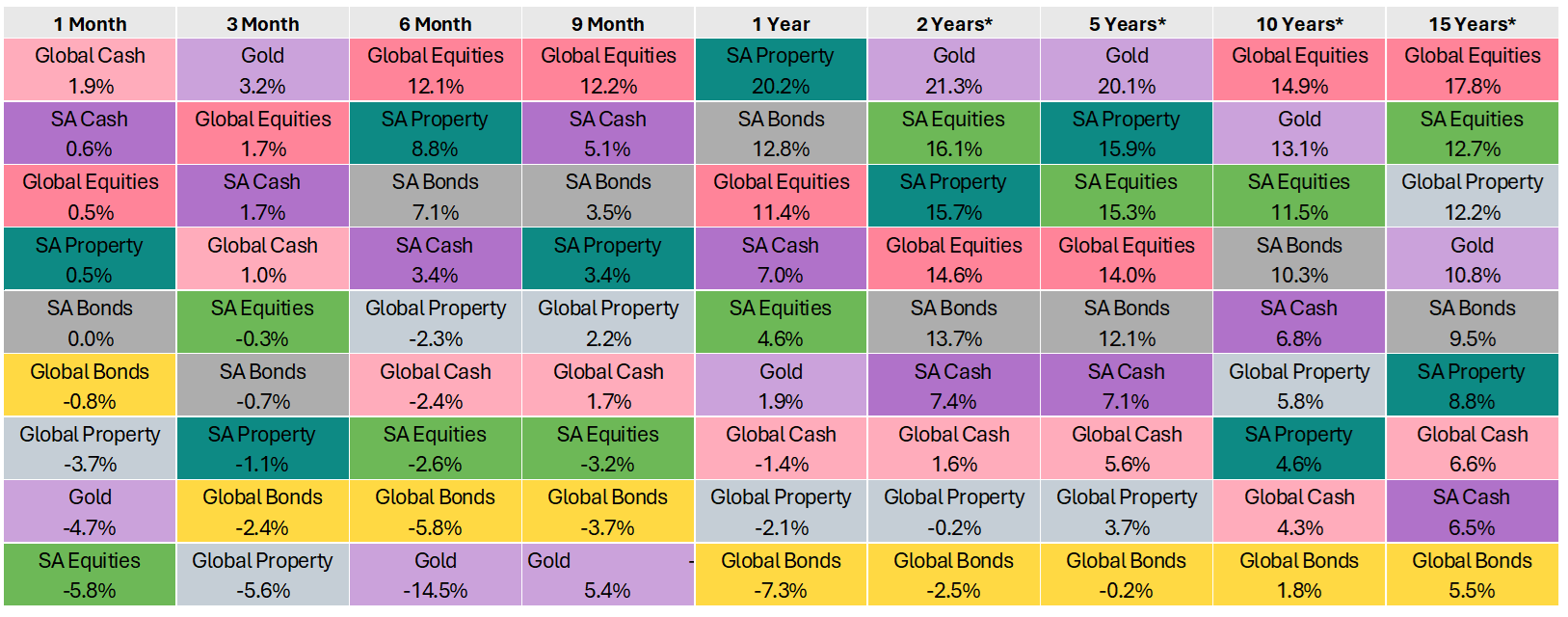
MONTHLY RETURNS: