INVESTMENT MARKET UPDATE
FEBRUARY 2026
What developments have unfolded in local and global markets throughout the month of FEBRUARY?
 +166.7%
1 year return on SA resources
 29.0%
29.0%
Largest difference in the 1-year performance differential of EM over DM since 2009 in USD
 R46,000
New Annual TFSA contribution limit

ADVANTAGE - FEBRUARY COMMENTARY:
GLOBAL MARKETS
__________________
🌐 A Push–Pull Market: resilient tape, higher energy, AI whipsaw
February delivered a month of steady global equity gains, even as the underlying market tone became more fractured. Semiconductor companies continued to expand their leadership while software stocks, particularly those most exposed to AI‑driven disruption, absorbed most of the downside. Developed markets were supported by broad US‑market resilience alongside firm performance across the UK and Europe. Emerging markets extended their outperformance for a third consecutive month, lifted by rising commodity prices, stronger semiconductor demand, and earlier‑month US‑dollar softness. As geopolitical tension in the Middle East escalated, energy and precious metals found renewed support into month‑end, reinforcing their role as key shock absorbers in a risk‑off environment.
The macro backdrop added its own layer of complexity. US inflation continued to ease, but labour‑market strength kept the Federal Reserve cautious, reinforcing the sense that rate cuts may be delayed. In Europe, central banks remained in a restrictive‑but‑steady posture, with both the ECB and BoE holding rates. Japan continued signalling its intention to gradually move away from ultra‑low interest‑rate settings. Together, these developments reflected a world of policy divergence, yet none were disruptive enough to undermine the broader narrative of slow but durable global growth.
Geopolitics, however, re‑entered the foreground. The late‑month US–Israel strikes on Iran introduced a new layer of uncertainty and raised the probability of supply disruptions, particularly as roughly 20% of global oil flows through the Strait of Hormuz. While global inventories and OPEC+ spare capacity offer buffers against short interruptions, the market remains highly sensitive to the duration and enforceability of any disruption. Haven assets such as gold—already in the midst of a strong multi‑month run—continued attracting flows, while the US dollar benefitted from a classic flight‑to‑safety bid.
Energy markets reacted fastest. Brent crude rose meaningfully as shipping constraints and insurance‑linked bottlenecks emerged. Precious metals also rallied, with gold prices—already historically elevated in real terms—pushing even higher. Asset‑manager commentary noted that gold’s valuation now carries asymmetric risks, with less upside and greater downside sensitivity, while platinum‑group metals look less extended relative to history. This divergence matters as volatility increases and correlations across metals rise.
Despite the noise, February behaved much like prior geopolitical shock episodes: markets react sharply at first, then stabilise as facts replace headlines. The greater long‑term risk is rarely the shock itself, but the behavioural response it provokes. Selling during periods of stress often results in missing the rebound, and history repeatedly shows that recoveries tend to begin before the narrative feels safe. For most investors, the real damage comes not from a volatile month, but from a decision made during a volatile month that limits future compounding.
Overall, February underscored how uncertainty moves faster than fundamentals, and how prices can move even faster still. While the Middle East conflict amplified volatility and kept energy markets elevated, it has not—at least for now—altered the broader trajectory of global growth. Should supply disruptions prove short‑lived, both oil prices and volatility may retreat; should they persist, the implications for inflation, shipping costs, and global activity could become much more pronounced. In this environment, diversification, discipline, and avoiding all‑or‑nothing decisions remain the most reliable tools for navigating a world dominated by noise but still anchored by an economy that is uneven, yet resilient.
Rand / US Dollar:
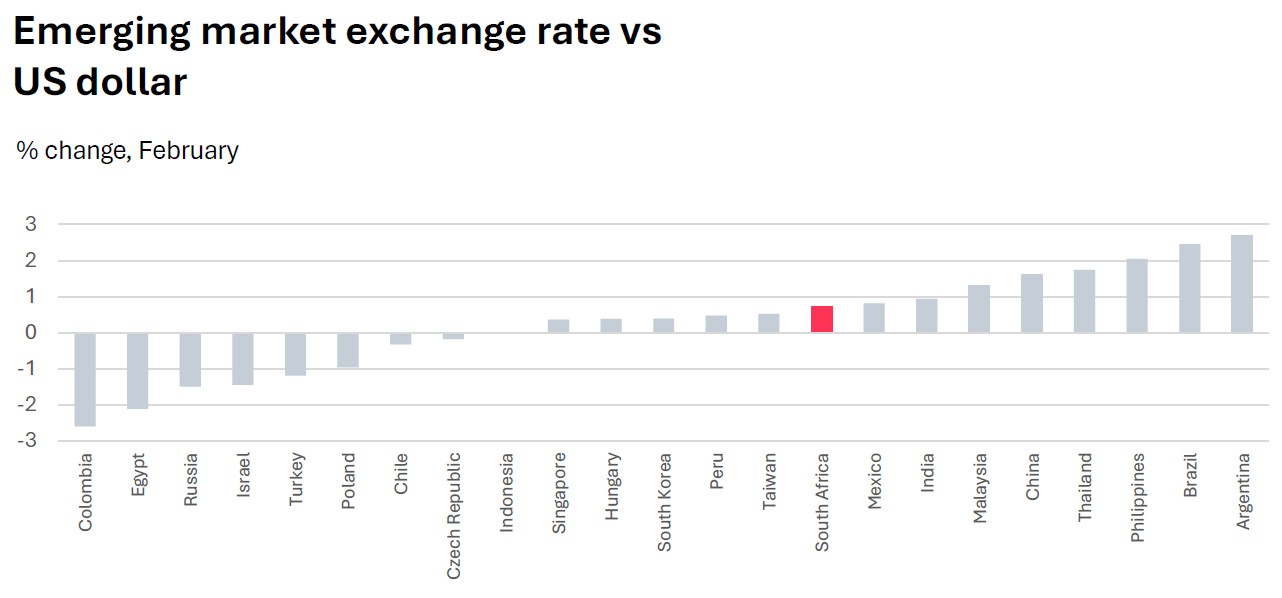
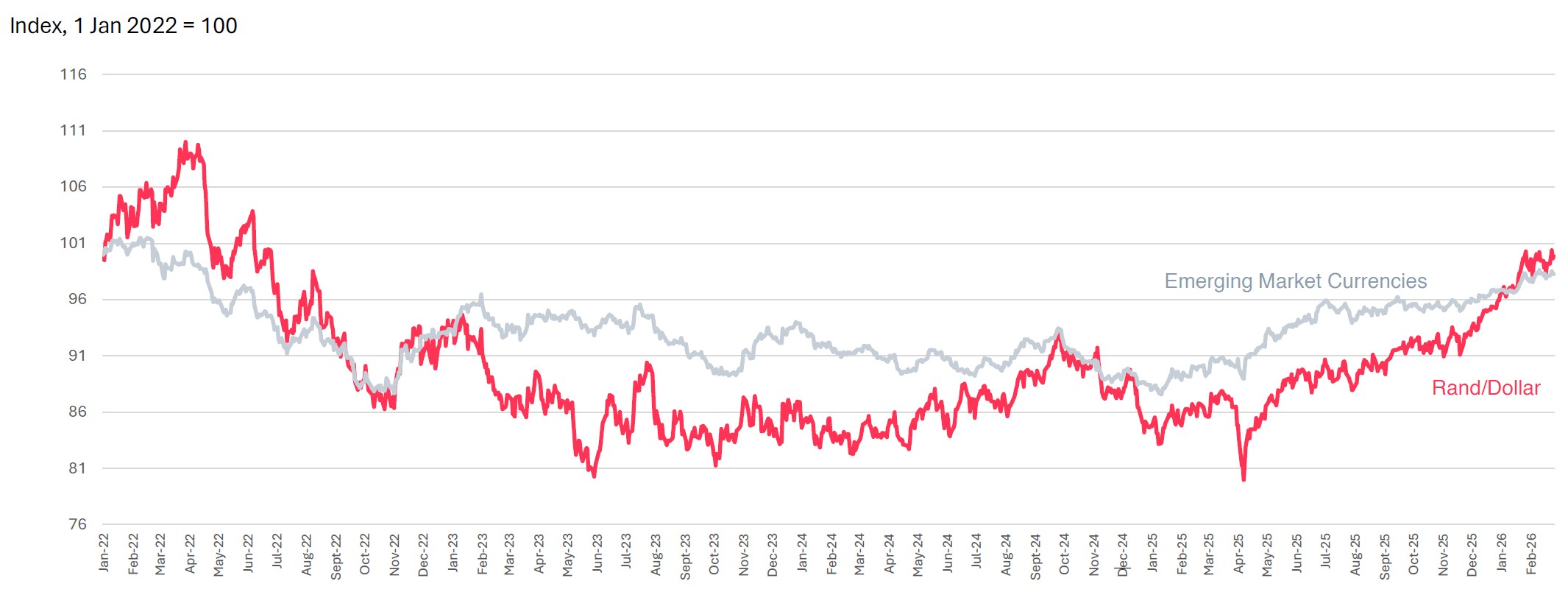
- In February, the rand gained 0.7% against the USD.
- The average monthly rand appreciation over the past 12 months against the USD has been 1.2% as at end February.
Rand / Euro:
- In February, the rand gained 0.9 % against the EUR.
- The average monthly rand appreciation over the past 12 months against the EUR has been 0.3% as at end February.
Rand / British Pound:
- In February, the rand gained 2.8% against the GBP.
- The average monthly rand appreciation over the past 12 months against the GBP has been 0.6% as at end February.
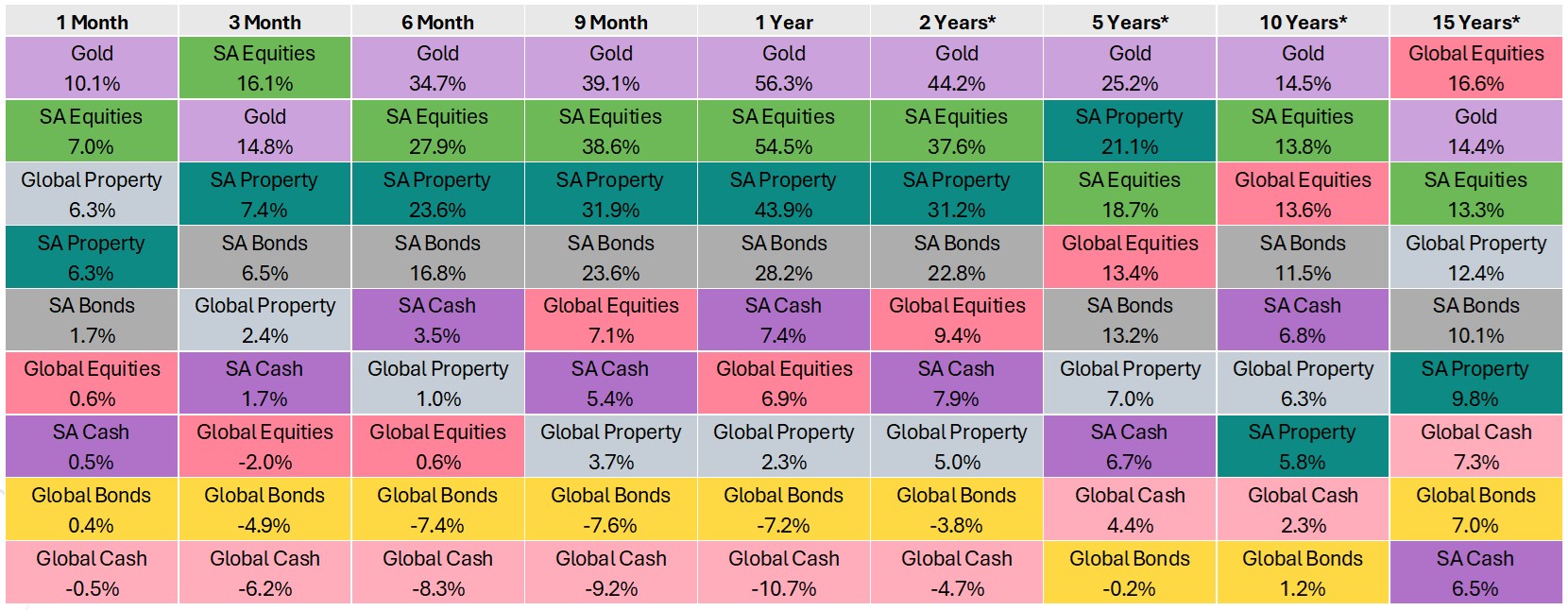
SMARTIE BOX IN RANDS:

LOCAL MARKETS
__________________
South Africa Holds Steady as Global Volatility Spikes
South African equities delivered high single‑digit gains, supported by continued strength in resources and strong performance from the financial sector. Markets reacted positively to the conservative Budget, which focused on fiscal discipline and supply‑side tax relief, helping anchor sentiment even as global volatility picked up.
Local bonds were initially firm, with yields declining and inflation‑linked bonds outperforming. The R28.8bn revenue overrun and full fiscal drag relief boosted confidence in the country’s fiscal trajectory. But this stability shifted late in the month as the Iran conflict triggered a global risk‑off move. For South Africa, this transmitted quickly through higher oil prices, a ~4.5% weaker rand, and a 20bps rise in the 10‑year bond yield. Rate‑cut expectations were sharply reduced, with the market now pricing just one 25bps cut instead of the 2–3 previously expected.
The inflation outlook has become more uncertain. Sustained oil strength and a weaker rand would likely push inflation forecasts higher than the earlier ~3% expectation. Rising fuel under‑recoveries—after March’s 20c/l petrol and 60–65c/l diesel increases—add further upside risk, particularly for lower‑income households.
A key institutional development came through the DA’s court victory confirming that only Parliament can change VAT, reinforcing fiscal oversight and reducing unilateral policy risk ahead of the election cycle.
Attention now turns to the SARB MPC on 26 March, where policymakers must balance still‑contained CPI (3.5%) with rising imported inflation pressures. The month ultimately highlighted South Africa’s improved domestic fundamentals—better budgeting, reform momentum, and resilient local markets—while also reminding investors how quickly global shocks can dominate local pricing. Maintaining diversification and avoiding reactionary positioning remains essential as geopolitical risks continue to shape the near‑term outlook.
2026 Budget speech
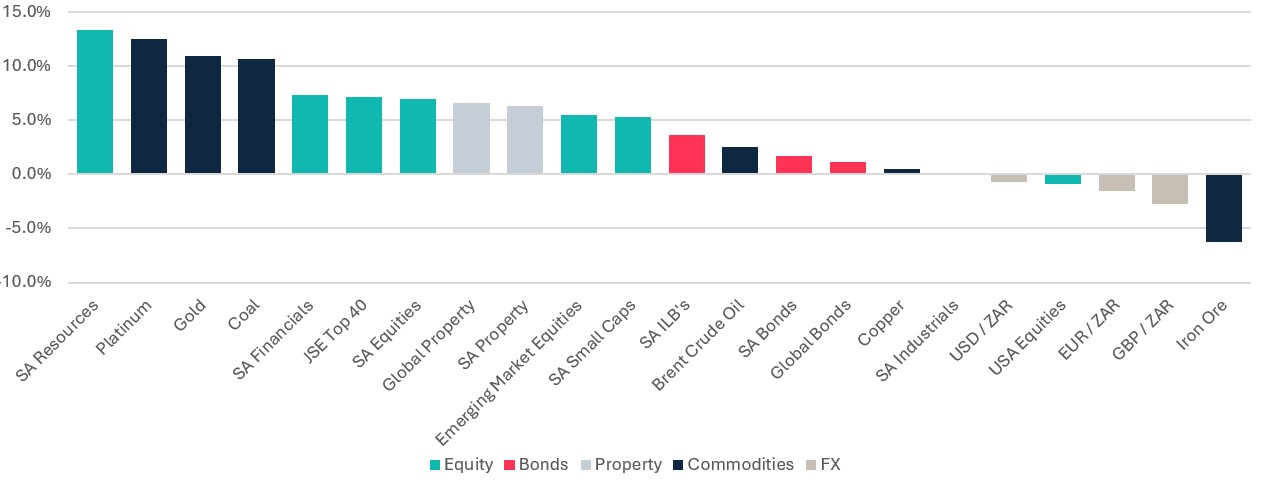
- The JSE All Share continued its 2026 momentum, gaining 7.0% over the month.
- Resources (up 13.3%) which jumped higher, and Financials (up 7.3%) pulled the local bourse upwards, as Industrials (up 0.1%) lagged in relative terms, detracting from the broader index.
- Small-caps (up 5.3%) soared, as Mid-caps (up 5.4%) edged ahead, and Large-caps (up 7.2%) raced to secure the top spot.
- SA Property markets grew substantially, as the ALPI added 6.3%, and the S&P SA REIT index gained 8.2%.
- SA Nominal Bonds (up 1.7%) added modest returns, and Inflation-Linked Bonds (up 3.7%) recorded a strong month.
- Developed Market Equities struggled to gain momentum, as the MSCI World Index (up 0.8% in USD) inched into the green in what was a bumpy month for developed markets. Emerging market equities, however, weren’t to be stopped, as the MSCI Emerging Market Index (up 5.5% in USD) closed significantly higher.
- The Rand strengthened in January, appreciating against major currencies. Relative to the US Dollar (Rand appreciated 0.7%), the Euro (Rand appreciated 1.5%) and the Pound Sterling (Rand appreciated 2.8%).
- Resources had a positive month, as Gold (up 11.0%), and Platinum (up 12.5%) gained double-digit returns. Brent Crude (up 16.2%) as geopolitical tensions increased.
MONTHLY RETURNS: