INVESTMENT MARKET UPDATE
MARCH 2026
What developments have unfolded in local and global markets throughout the month of MARCH?
 3%
3%
SA CPI decreased slightly
 -11.1% ($)
Gold had its worst monthly drop since June 2013
 6.75%
6.75%
The SARB maintained its lending rate at the same level

ADVANTAGE - MARCH COMMENTARY:
GLOBAL MARKETS
__________________
🌐 When geopolitics overwhelm fundamentals: oil shocks, policy caution, and risk repricing
March marked a sharp shift in market tone as geopolitical risk moved from background noise to the dominant driver of asset prices. The escalation of the US–Israel–Iran conflict, and Iran’s partial closure of the Strait of Hormuz, triggered a sudden repricing across global markets. With roughly 20% of global oil supply flowing through this corridor, the shock was immediate: oil prices surged, inflation expectations jumped, and risk appetite deteriorated rapidly.
Global equities sold off meaningfully over the month, with losses broad‑based across regions and styles. US markets experienced their longest losing streak in several years, while Europe and Asia were pulled lower by higher energy costs and renewed uncertainty around global growth. Emerging markets were particularly affected as higher oil prices, a stronger US dollar, and tightening financial conditions combined to pressure capital flows.
Unlike earlier phases of the year, diversification within equities offered limited shelter. Technology and growth stocks weakened as higher energy prices and inflation fears pushed bond yields higher and reduced confidence in near‑term rate cuts. Even traditional defensive assets behaved unevenly: gold, after a powerful multi‑month rally, saw sharp profit‑taking as investors raised liquidity and the US dollar strengthened further.
The macro backdrop deteriorated alongside markets. While inflation had been easing into February, the oil shock reintroduced upside risk at precisely the wrong moment. Central banks responded predictably by stepping back from any urgency to ease policy. The US Federal Reserve, ECB, and Bank of England all remained on hold, reinforcing a growing consensus that rates will stay higher for longer unless growth weakens materially. Bond markets, rather than providing protection, also came under pressure as yields rose and volatility increased.
Commodities were the clearest expression of the shock. Oil prices spiked dramatically as markets priced the risk of prolonged supply disruption and damage to energy infrastructure. Industrial metals weakened on growth concerns, while precious metals lost ground as investors rotated into cash and the US dollar. The message was clear: in stress environments driven by inflationary shocks, correlations rise and liquidity matters.
Despite the severity of the moves, March followed a familiar pattern seen in past geopolitical crises. Markets moved first and asked questions later. History suggests that while shocks can be violent, they are rarely permanent drivers of long‑term returns. The greater risk for investors is not volatility itself, but reactionary decisions made during periods when uncertainty feels overwhelming.
March served as a reminder that markets are forward‑looking but emotionally reactive. When geopolitical risk collides with inflation sensitivity, prices adjust quickly — often overshooting fundamentals in the process. In such environments, maintaining diversification, resisting binary decisions, and allowing portfolios time to absorb shocks remains critical.
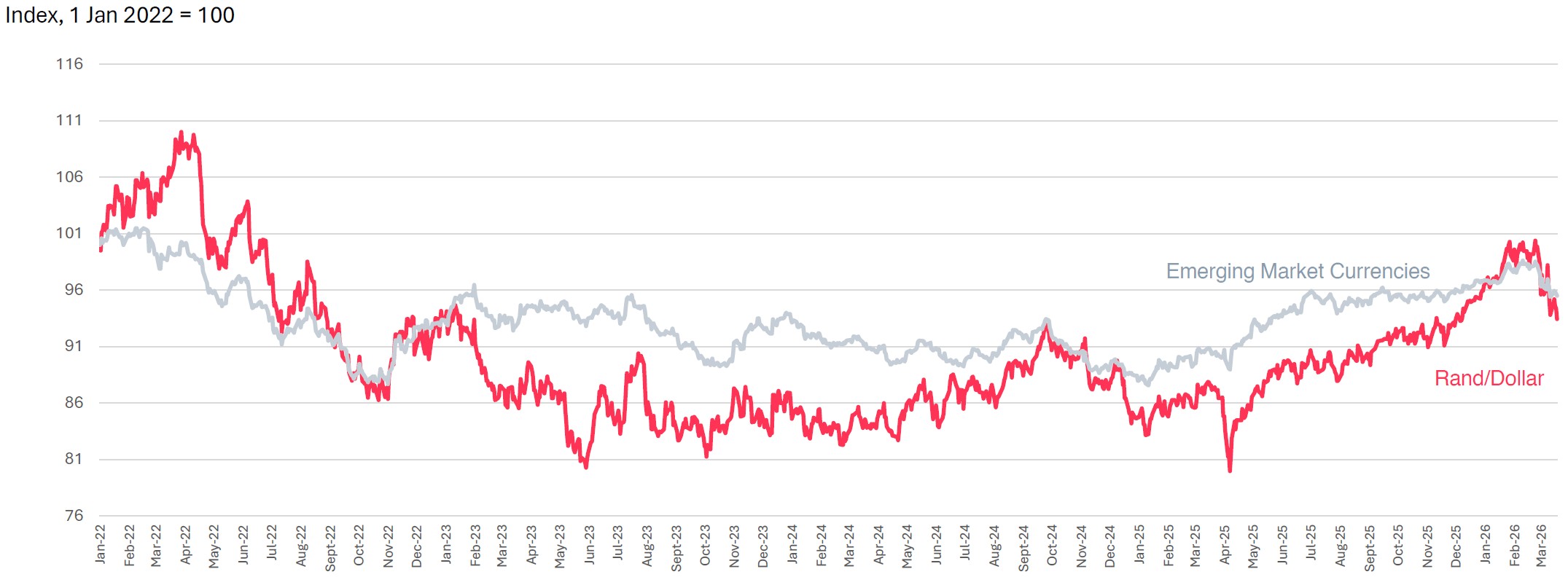
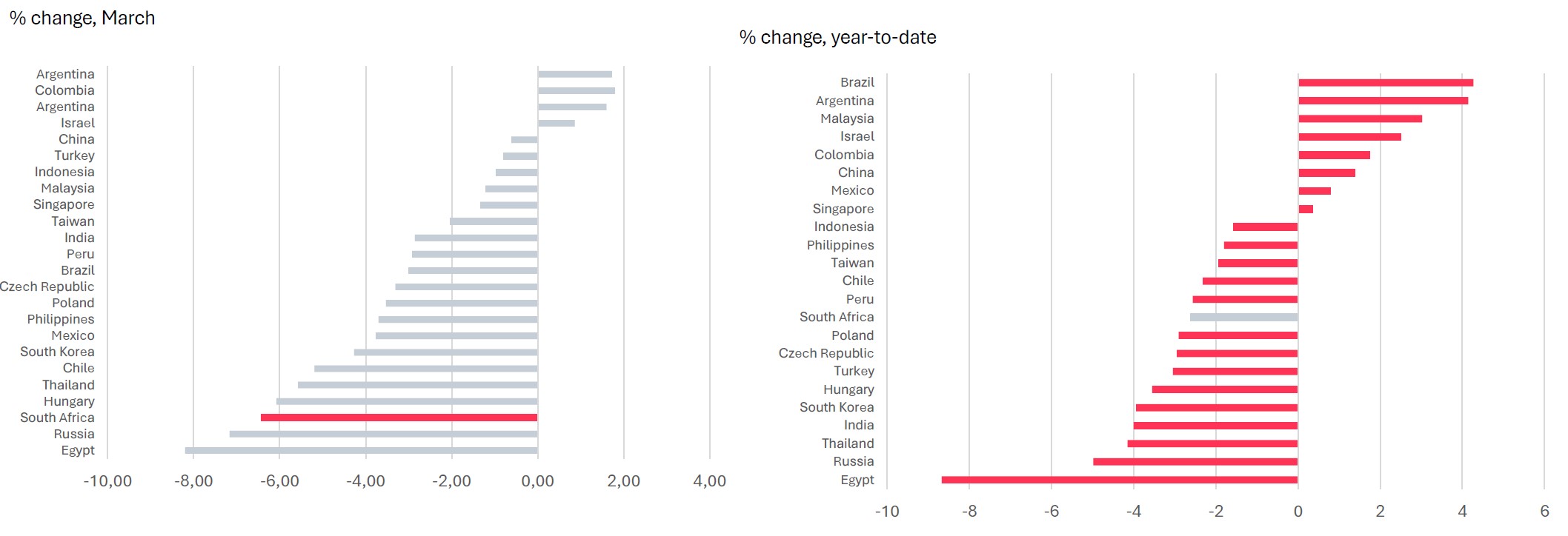
Rand / US Dollar:
- Year-end 2025 level was R16.56/USD. In 2025, the rand gained a substantial 13.3% against the USD.
Rand / Euro:
- Year-end 2025 close level was at R19.44/EUR. In 2025, the rand gained 0.9% against the EUR.
Rand / British Pound:
- Year-end 2025 level was R22.28/GBP. In 2025, the rand gained 6.1% against the GBP.
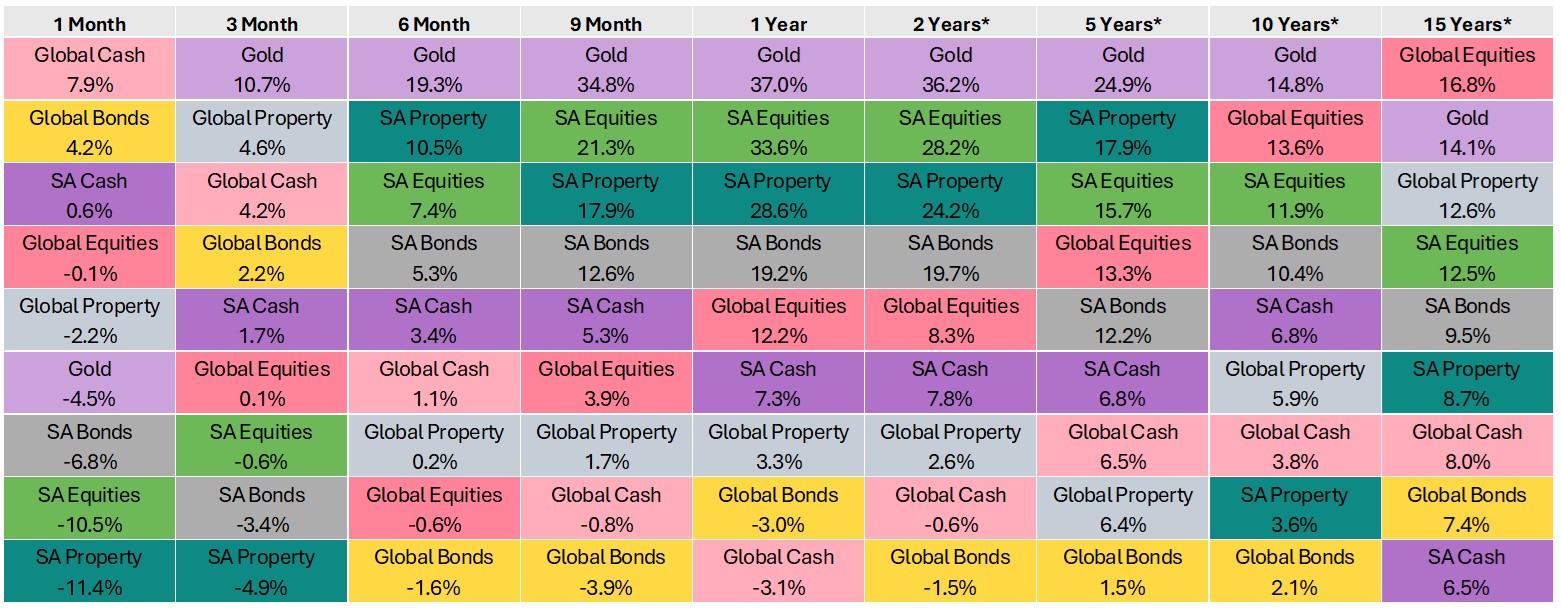
SMARTIE BOX IN RANDS:
LOCAL MARKETS
__________________
South Africa: global shocks overwhelm improving domestic fundamentals
South African markets experienced one of their most difficult months in years as global risk aversion fed directly into local asset prices. Equities, bonds, and the rand all weakened sharply, despite no meaningful deterioration in domestic fundamentals. The transmission mechanism was clear: higher oil prices, a stronger US dollar, and reduced appetite for emerging‑market risk.
Local equities fell heavily, led by sharp declines in the Resources sector as precious‑metal prices corrected and global growth concerns intensified. Financials and Industrials also weakened, reflecting higher bond yields, currency pressure, and deteriorating global sentiment. In rand terms, the All Share Index recorded its worst monthly performance since the COVID period.
The bond market offered little refuge. Government bond yields rose sharply as investors priced higher imported inflation and pushed out expectations for interest‑rate cuts. Even inflation‑linked bonds came under pressure as real yields rose in a global sell‑off. The rand weakened materially against the US dollar, amplifying offshore volatility for local investors and reinforcing South Africa’s sensitivity to global shocks.
From a policy perspective, the South African Reserve Bank held rates unchanged at 6.75%, acknowledging that while inflation remains contained for now, the balance of risks has shifted higher. Sustained oil strength and currency weakness increase the probability of inflation surprises later in the year, reducing the room for near‑term easing.
Importantly, March did not invalidate South Africa’s improving structural narrative. Fiscal discipline, better budgeting assumptions, and institutional resilience remain intact. However, the month highlighted how quickly global dynamics can dominate local pricing, regardless of domestic progress.
Viewed through a balanced‑portfolio lens, the damage was more contained. Diversified portfolios absorbed the shock better than headline equity indices, reinforcing the role of asset allocation in navigating volatile periods.
As with global markets, March was a test of temperament. The temptation to respond to volatility is strongest when prices move fastest — yet history suggests that patience during such periods is often rewarded.
Is Cheaper Always Better in retirement?
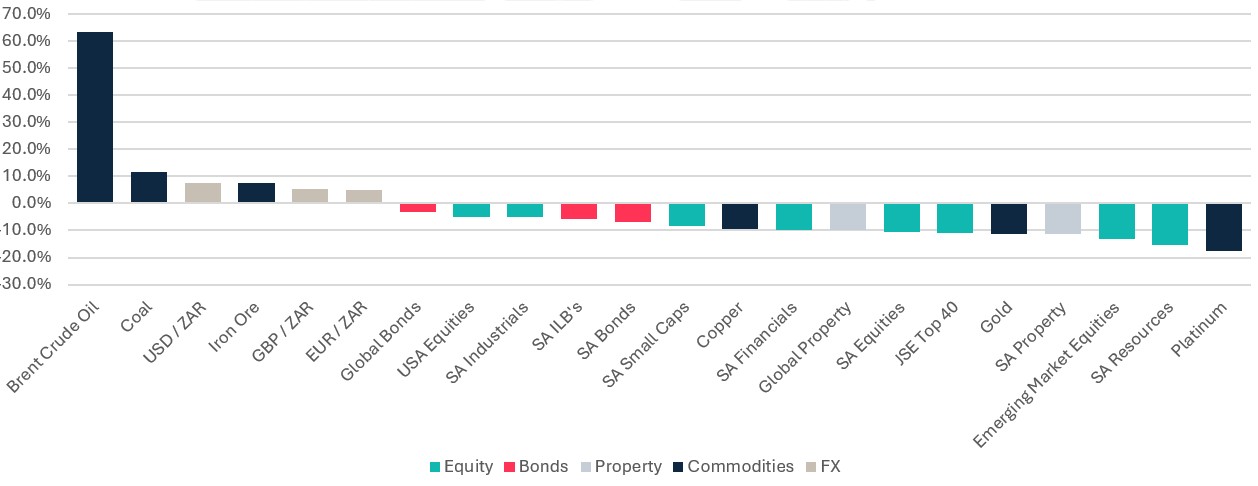
- The JSE All Share ended its winning streak, losing 10.5% over the month.
- Resources (down 15.2%) plummeted, and Financials (down 9.6%) tumbled, as Industrials (down 5.2%) managed to outperform the other sectors in the drawdown.
- Small-caps (down 8.2%) dropped, Mid-caps (down 11.7%) fell, and Large-caps (down 10.9%) trended lower in market conditions without reprieve.
- SA Property markets didn’t fare any better, as the ALPI lost 11.7%, and the S&P SA REIT Index nosedived 13.6%.
- SA Nominal Bonds (down 6.8%) had a shocking month, and Inflation-Linked Bonds (down 5.9%) dipped lower.
- Developed Market Equities weren’t safe from global risk off sentiment, as the MSCI World Index (down 6.3% in USD) ended far in the red. Emerging market equities, underperformed their developed peers, as the MSCI Emerging Market Index (down 13.0% in USD) closed significantly lower.
- The Rand weakened against major currencies ending an almost year-long rally. Relative to the US Dollar (Rand depreciated 7.5%),the Euro (Rand depreciated 4.9%) and the Pound Sterling (Rand depreciated 5.5%).
- Resources were most correlated to the rest of the markets, as Gold (down 11.1%), and Platinum (down 17.6%) lost double-digit returns. Brent Crude however (up 63.3%) as the Iranian war escalated throughout March.
MONTHLY RETURNS: