INVESTMENT MARKET UPDATE
MARCH 2025
What developments have unfolded in local and global markets throughout the month of MARCH?

 1986
1986
The last time gold gained 17% in one quarter
 7.1%
7.1%
Annual growth rate of debt servicing costs in SA
 5%
5%
EM outperformance of DM in March 2025
GLOBAL MARKET
_______________________
Q1 2025 Market Update: A Turbulent Start Amid Rising Policy Uncertainty
ANALYTICS - COMMENTARY FOR MARCH:
SMARTIE BOX IN RANDS:

LOCAL MARKETS
__________________________
South Africa Market Update: Fiscal Policy Adjustments and Market Resilience in Q1 2025
In South Africa, investor focus in the first quarter of 2025 shifted to the evolving national budget process. The Government of National Unity (GNU) continued to manage a complex political environment, with the Democratic Alliance (DA) withholding its support for the initial budget proposal due to opposition to a proposed VAT increase. This prompted the Treasury to issue a revised draft in March.
The updated budget introduced a more measured approach to VAT adjustments—implementing a phased increase of 0.5% in both 2025 and 2026, compared to the initially proposed 2% hike. Despite these revisions, Treasury maintained its commitment to fiscal consolidation. A cornerstone of the updated budget is a R47 billion allocation over three years toward growth-enhancing infrastructure projects, underscoring a long-term strategy to stimulate economic activity while maintaining fiscal discipline.
The revised budget also forecasts a slightly higher peak in the debt-to-GDP ratio—76.2%, compared to 75.5% projected in the 2024 Medium-Term Budget Policy Statement (MTBPS)—but outlines a path to stabilisation supported by expected primary budget surpluses in the coming years.
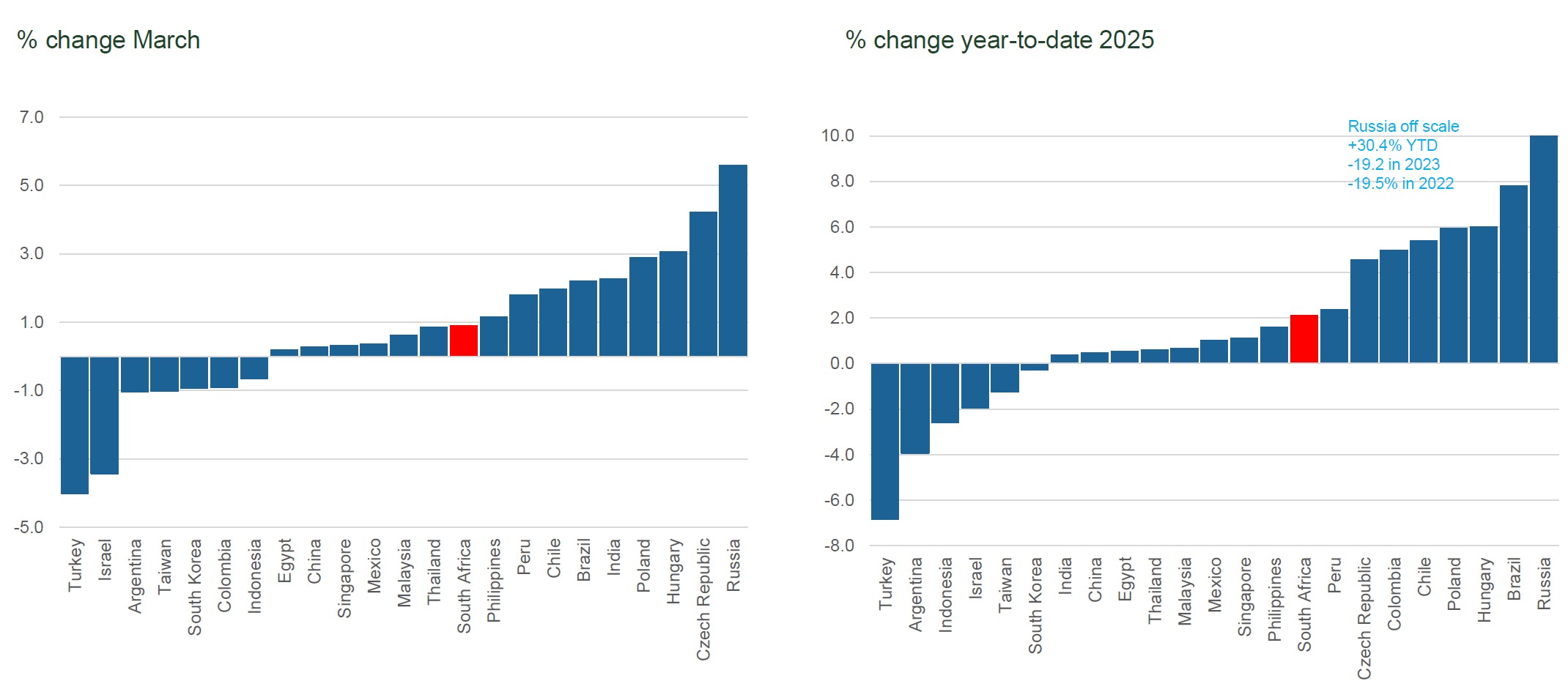
Market reaction was broadly positive. South African equities delivered a robust performance in March, returning 3.6% in Rand terms. Gains were largely driven by the resources sector, as gold mining stocks rallied alongside a sharp rise in the global gold price. This local performance outpaced broader emerging market benchmarks, with the MSCI Emerging Markets Index rising just 0.6% in US dollar terms over the same period.
The South African Reserve Bank (SARB) held interest rates steady at 7.5% during its March Monetary Policy Committee (MPC) meeting, following three consecutive 25 basis point cuts. Notably, two of the six MPC members voted in favour of another rate cut, suggesting an ongoing debate about the appropriate path forward for monetary policy.
After an initial delay in February, Finance Minister Enoch Godongwana delivered the 2025 Budget Speech in March, formally outlining the revised VAT trajectory. The speech reaffirmed government’s focus on fiscal prudence while attempting to balance the social and political complexities of a multi-party coalition.
Looking ahead, market participants will be closely watching both the implementation of fiscal measures and the political cohesion of the GNU as key factors influencing investor confidence and economic performance.
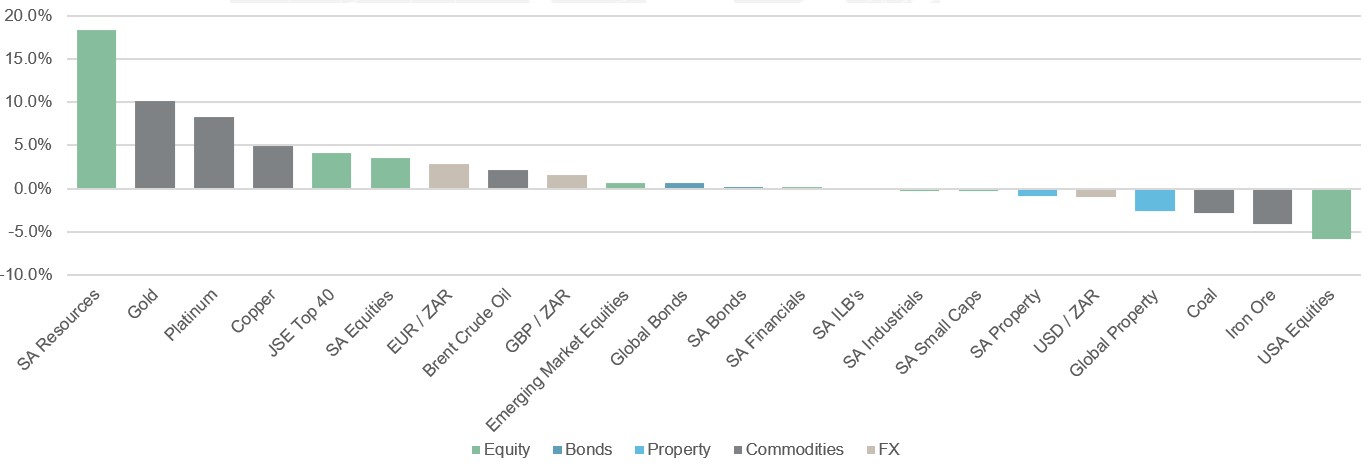
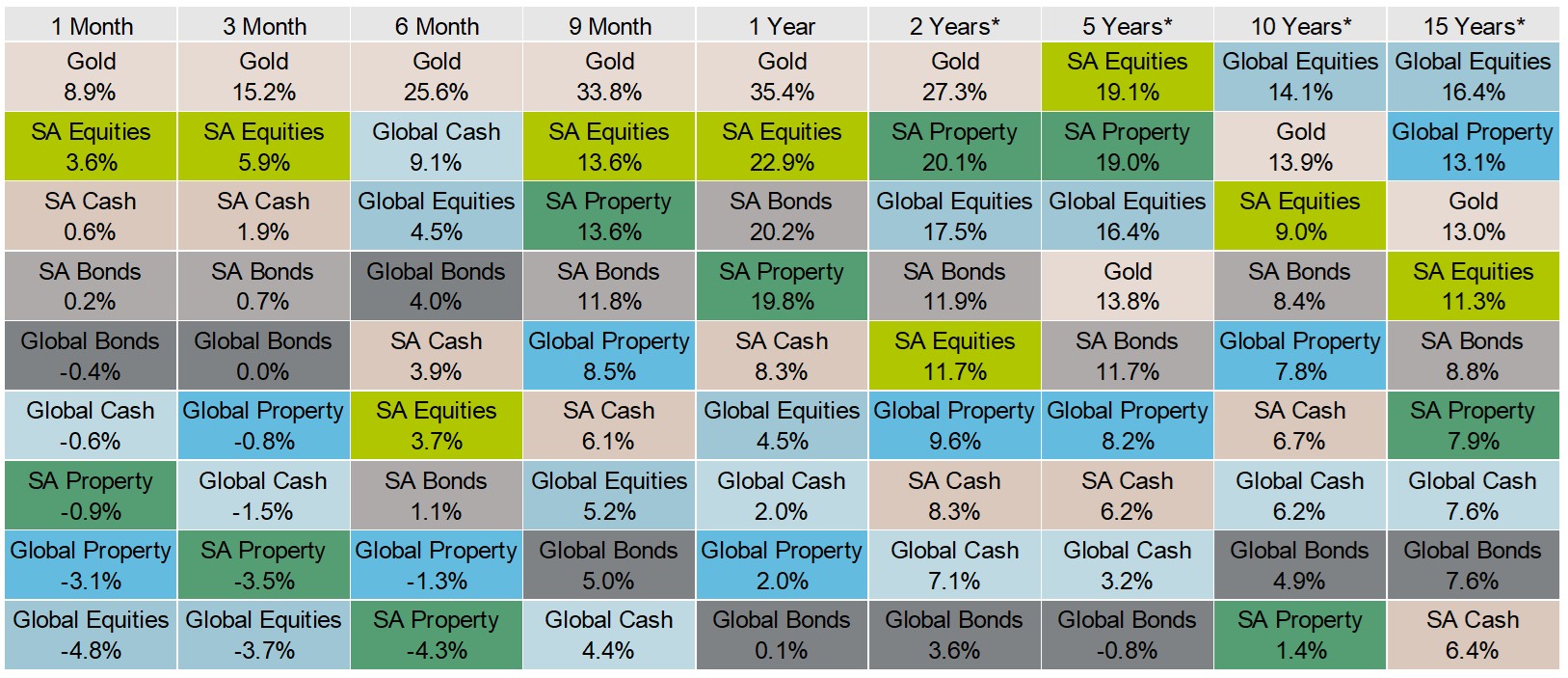
- The JSE All Share traded sharply higher in March, up 3.6%.
- Resources (up 18.4%) bounced back in a big way from the previous month’s decline, while Industrials (down 0.3%) and Financials (up 0.2%) traded somewhat flat over the month.
- Small-caps (down 0.3%) delivered slightly negative performance, while Mid-caps (up 3.7%) and Large-caps (up 4.1%) delivered strong gains.
- SA Property had yest another volatile month, as the S&P SA REIT index (down 1.7%) dipped, and the SA Listed Property index (down 0.9%) ended slightly lower for a third consecutive month.
- SA Nominal Bonds (up 0.2%) crept higher again over the month as bond yields continued to move higher, while Inflation-Linked Bonds were flat (up 0.0%).
- Emerging Market Equities outperformed Developed Market Equities in US Dollar terms in March. The MSCI World Index dropped sharply 4.4% and the MSCI Emerging Market Index rose 0.7%.
- The rand had another mixed month. Relative to the US Dollar (Rand appreciated 1.0%), the Euro (Rand depreciated 2.9%) and the Pound Sterling (Rand depreciated 1.5%).
- Commodity prices rose across the board in March, as the Gold price surged higher up 10.1% Platinum bounced back up 8.3%) after the fall in February, and the price of Brent Crude increased by 2.1%.
MARKETS REACT TO TRUMP TARIFFS:
MONTHLY RETURNS: